
Hall of Mirrors

Our language is giving us away.
We talk about “nondegree” credentials, “noncollege” routes, and “alternative” pathways. That phrasing reflects binary thinking: either young people are going to college or they’re not. It also implies that bachelor’s degrees (which are still what too many people mean when they say “college”) are the default. Calling something an “alternative” is another way of saying it’s not the norm, and referring to “nondegree” and “noncollege” options sets up degrees and college as the standard. This language is pervasive in the pathways movement, even as we say that pathways are reframing the narrative about postsecondary options. In reality, our language sets up bachelor’s degrees as the thing young people pursue if they can, while everything else is a fallback for those who don’t have access to—or envision—that first-choice option.
In our last post, we argued in favor of pathways that offer real choices and respond to the developmental need of young people to explore and take risks. Designing pathways that meet that need isn’t just a matter of adding in some additional career exploration activities. If we want young people to thrive, then we need to take a hard look at how our current narratives and strategies are getting in our way. We’re starting with the assumptions we’ve made about which postsecondary education options pathways should prioritize—and considering how those assumptions have fostered pathways designs that offer more dead ends than opportunities. We’re focusing in this post on credentials and bachelor’s degrees because they’ve been the poles of the false choice embedded in too many pathways. Associate’s degrees also deserve our thoughtful consideration, and we’ll have more to say about them in a future post.
If young people with the resources to do so get to pursue bachelor’s degrees, while others get “alternatives,” then we’re not creating opportunity or offering real choice. Instead, we’re building a second-class education system that forecloses opportunity by design and then calling it an equity strategy.
For more than a decade, we’ve worked to build pathways focused on sub-baccalaureate credentials. Part of the story we told about our work was that pathways were meant to lead to a “first” credential that opened the door to both meaningful career opportunities and further education. But we never looked through the door to make sure it led where we said it did, let alone spent any time building anything on the other side of it.
As a result, what we’ve constructed looks more like a funhouse. From the outside, it promises excitement, choice, and something for everyone. But inside, there are mirrors that distort reality. Credentials that appeared to be sure bets turn out to be dead ends. Doors that seemed to open onto opportunity lead nowhere. And young people trying to find their way through can’t tell which reflections are accurate and which doors are real. We told ourselves a story and then we built a funhouse based on it.
The story we’ve been telling
We’ve created a narrative that says a focus on sub-baccalaureate credential attainment is an essential element of equitable pathways strategies. It goes something like this:
Bachelor’s degrees are risky, and the opportunity cost is high. They take too long, they’re too expensive, and too few students complete them. And, even for those who do complete them, they too often lead to underemployment and an untenable burden of student loan debt. And to top it all off, AI is threatening the knowledge economy jobs held by those with bachelor’s degrees. Credentials, on the other hand, offer a fast, accessible route to good jobs because employers are looking for credentialed workers to fill a skills gap. With the right industry-recognized credentials, young people can get $60,000-a-year jobs in fields like welding straight out of high school. And, for students who want to go on to further education, those credentials are just a first step toward a wide range of postsecondary options that are made accessible thanks to stackable credentials.
This narrative feels true. It’s based on real problems, including polling that shows declining public confidence in higher education, disappointing transfer and completion rates, young people saddled with student debt, and rising unemployment among bachelor’s degree holders. And it’s a story that’s captured the attention of national publications like the Atlantic, New York Times, Wall Street Journal, and Washington Post, all of which keep churning out articles and opinion pieces debating the value of bachelor’s degrees. Meanwhile, the media has been assuring us that skills-based hiring is on the rise, creating a new route to good jobs in state governments and major corporations.
Our narrative sets up the creation of alternatives to bachelor’s degrees as an equity play. It claims we’re disrupting a system of higher education in which elite institutions have too often played a gatekeeping role and locked out the young people furthest from opportunity. It says that we’re democratizing access to education and good jobs through stackable credentials that give young people a head start on both higher education and careers. It positions pathways as meeting young people where they are instead of trying to force them to adapt to and navigate through systems that weren’t built for them in the first place.
We believed this story and have spent more than a decade peddling it. (And it’s been very convincing! The story had legs.) It was the lens through which we saw almost any challenge or opportunity in our work. But now we’re rethinking it. We’re concerned that it’s a narrative that established a zero-sum game in which credentials and degrees are competing alternatives instead of complementary components of pathways with no dead ends. Pathways shouldn’t ask young people to choose between what we said was the pragmatic credential route or the risky bachelor’s degree route. We framed it as expanding opportunity and choice for young people. But false choices aren’t really choices at all. The story we’ve been telling may feel true, but the evidence reveals a hall of mirrors.
Pathways shouldn’t ask young people to choose between what we said was the pragmatic credential route or the risky bachelor’s degree route. We framed it as expanding opportunity and choice for young people. But false choices aren’t really choices at all. The story we’ve been telling may feel true, but the evidence reveals a hall of mirrors.
Certificates and badges and microcredentials, oh my!
So what does the evidence actually show about the credentials we’ve been championing? In the funhouse mirror, credentials gleam with promise: they’re fast, practical, and aligned to jobs. But if we step back from the mirror and look at the actual data, the reflection distorts.
Those $60,000/year welding jobs do exist—and show up in pathways brochures and pitch decks in an “ignite a bright future for yourself” sort of way—but they’re the top of the distribution for credential holders, not the norm. The Community College Research Center found that median earnings two years after graduation for those who complete workforce certificates at community colleges are just $32,487. Just 12 percent of 23,000 credentials analyzed by the Burning Glass Institute led to real wage gains. And any earnings bump that credential holders manage to achieve often disappears just a few years after completion. Similar data exists for industry-recognized credentials (IRCs) earned by high school students. A Fordham Institute study found that the correlation between IRCs earned by high school students and improved short-term employment prospects is weak, and just a few specific IRCs are associated with increases in earnings—and those increases are short term. New America has noted that half of adults with short-term credentials earn poverty-level wages, about 40 percent are unemployed, and there are significant racial and gender disparities in the returns to credentials.
It is true that there are some promising credentials that can put earners on a path to good jobs and career advancement. If 12 percent of 23,000 credentials have value, that works out to about 2,700 credentials of value. That’s not a small number, and there are many more credentials available beyond those 23,000. The best credentials can boost earnings by $5,000 annually, and have even stronger positive effects on earners’ promotion prospects and ability to switch careers. (Which also suggests that credentials may be a better bet for working adults than for young people seeking to get an initial foothold in the labor market.) It is also true that there are good middle-skills jobs for which employers are experiencing a shortage of qualified workers—though the same credentials needed to access those jobs can also lead to low-wage positions.
However, those promising credentials are hidden in a landscape that’s almost impossible to navigate. Learners in the U.S. have an overwhelming choice of more than 1.5 million postsecondary credentials, not counting associate’s and bachelor’s degrees. And that number is growing at a dizzying rate, virtually doubling between 2022 and 2025. This growth is powered by massive public and private expenditures: states alone have invested nearly $10 billion, and private education and training organizations that offer only “nondegree credentials” spend about $30 billion annually. This growth has happened without consensus about how to define credential quality or an understanding of the outcomes of the vast majority of credentials.
We scaled before we had evidence, and now we’ve created a funhouse maze with 1.5 million doors, but no signs indicating which doors open onto opportunity and which ones open onto brick walls. Even the very best education and career navigation systems can’t keep up with such an extensive and unregulated credential ecosystem. And there are real risks for young people who choose the wrong door. The median monthly cost of attendance for a certificate program is between $2,000 and $3,000—and can climb as high as $26,000 per month—with over half of learners paying out of pocket for short-term programs. That’s a big investment in a credential with uncertain wage and employment outcomes.
Nor does the data bear out our story about how first postsecondary credentials leave the door open to further education. It’s rare for those who complete a first credential to go on to “stack” it with a second credential, and only five percent of learners in workforce credential programs go on to enroll in postsecondary programs that lead to degrees.
Can’t get enough of the data on credentials?
We’ve got you covered. We put together a handy appendix that includes the data cited here, plus still more of the research we’ve been looking at as we try to understand the world of credentials.
Check out the appendix on credentials:

In short: while some credentials can open doors to good jobs, pursuing one is a risky bet. Too many credentials do not improve outcomes for learners and create dead ends within pathways. And with 1.5 million credentials to sort through, plus a lack of outcomes data about most of them, it’s very challenging to identify which credentials lead to opportunity and which foreclose it. Yet we keep embedding them in pathways systems and incorporating attainment metrics for them in accountability systems. When we listen to the story the data is telling, the funhouse mirror cracks. The promising reflection that showed credentials as the practical path to good jobs gives way to a more troubling picture: a maze filled with doors that lead nowhere, with young people paying real costs for credentials with uncertain returns.
Reports of the death of the bachelor’s degree have been greatly exaggerated
In the distorted reflection of the funhouse mirror, bachelor’s degrees loom large and menacing—too expensive, too risky, increasingly irrelevant. Those concerns have been essential to justifying our focus on credentials: if bachelor’s degrees are a bad bet, then building alternatives isn’t just reasonable, it’s an equity imperative. But when we look at the actual data, we have to admit that many of our concerns about them were more vibes-based than rooted in evidence. Perhaps we’re not alone in that.
The value of a bachelor’s degree isn’t a matter of opinion. There is a wealth (we leave it to you to decide whether that pun was intentional) of rigorous research conclusively demonstrating the economic benefits of earning a bachelor’s degree. The idea that bachelor’s degrees pay off in the form of higher earnings—what’s known as the “college wage premium”—is quite uncontroversial among economists. Young workers ages 25 to 34 with bachelor’s degrees can expect wages 35 percent higher than those earned by workers with associate’s degrees. These differences in earnings have proven durable, with similar disparities appearing in the data every year since 2012. (See Figure 1.) That difference in earnings approximately doubles by age 60. Household wealth also increases with educational attainment, although educational attainment alone is insufficient to close racial wealth gaps.
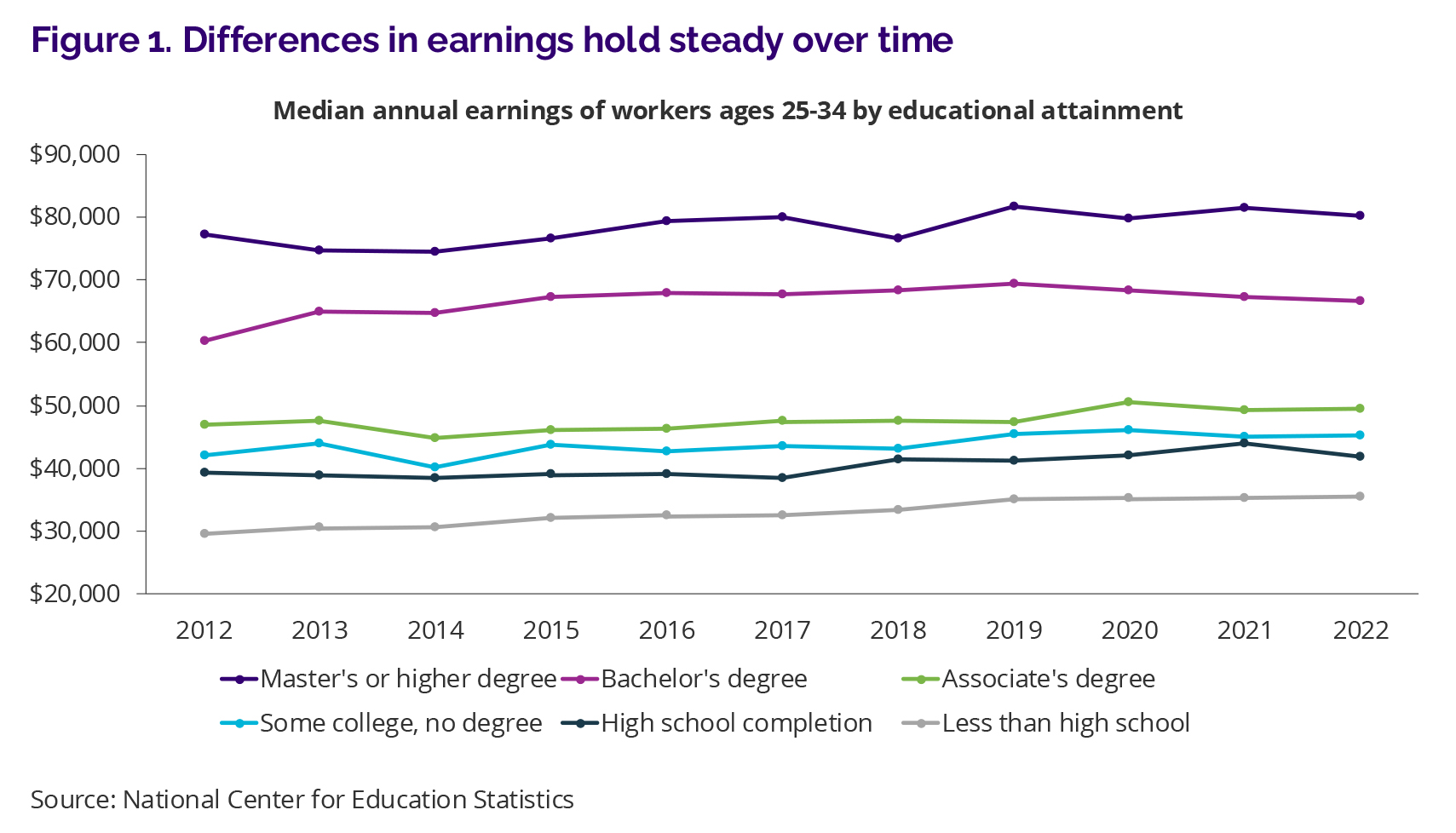
Labor market projections offer plenty of reason to expect a continuation of the college wage premium. The Georgetown University Center on Education and the Workforce (CEW) forecasts growing employer demand for workers with bachelor’s degrees, which will become increasingly important to securing a good job. By 2031, two-thirds of good jobs in the U.S. will require a bachelor’s degree. Only 19 percent of good jobs will be accessible to those with sub-baccalaureate degrees and credentials, barely more than the 15 percent of good jobs that will be available to those with just a high school diploma.
Yes, we’ve seen the apocalyptic headlines like “AI is not just ending entry-level jobs. It’s the end of the career ladder as we know it.” The economists at CEW aren’t persuaded that these undermine their projections, and neither are we. The implications of AI for bachelor’s degree holders are murky at best, with rigorous research pointing in multiple directions. Reports from Stanford and the Burning Glass Institute see quite a lot of cause for concern about AI’s implications for young workers, while research from MIT and Brookings and Yale suggests it’s premature to attribute the recent uptick in unemployment among new graduates to AI. Even if AI is already affecting the career prospects of newly minted bachelor’s degree holders, it doesn’t necessarily follow that doubling down on middle-skill options is the solution. Young workers with bachelor’s degrees are still less likely to be unemployed their peers, and there’s some evidence AI is making bachelor’s degrees more important, not less. As AI-generated resumes flood the market, employers are increasingly relying on GPAs and degrees from elite institutions to distinguish among job candidates. AI is also increasing employer demand for durable skills, which are at the core of college liberal arts curricula. None other than Anthropic co-founder and AI maven Daniela Amodei recently said that, because of AI, “studying the humanities is going to be more important than ever” thanks to their disciplinary focus on what makes us uniquely human.
None of which solves the issue of college affordability, but that’s another topic on which more optimism may be warranted than the headlines would suggest. The idea of constantly rising college tuition and fees has become a truism, but it’s not entirely accurate. While sticker prices have risen, net tuition—what students pay after financial aid is applied—has declined in recent years and was basically flat between 1990 and 2020 for students with low incomes at public colleges. Student loan debt is a very real problem—but still doesn’t undermine the economic value of earning a bachelor’s degree. New research on the “debt-adjusted earnings” of graduates found that, after subtracting their student loan payments from their total earnings, those with student loan debt still earn about $8,000 per year more than their peers without degrees. And student debt isn’t a challenge unique to those who pursue bachelor’s degrees. Across all institution types (public, private, and for-profit), the average annual loan amount for a student in a bachelor’s degree program is $8,320, while for a student at a two-year college, it is $5,845. An annual difference of about $2,500 is significant, but substantially less than the wage premium for a bachelor’s degree.
Earning a bachelor’s degree also helps to create the broader set of conditions necessary for young people to move from striving to thriving. College graduates are healthier than their peers, even after controlling for economic and social factors that influence college attendance. Bachelor’s degree holders live an average of eight-and-a-half years longer than those with lower levels of educational attainment, a gap that has tripled over the last three decades and continues to grow. Bachelor’s degree attainment is also correlated with the development of precisely the sense of belonging and kinds of social and community connections that young people need. Community and political engagement—including voter participation, volunteerism, and participation in community and civic organizations—increases with educational attainment. And there is an inverse relationship between educational attainment and preferences for authoritarianism or a lack of support for democracy.
What, you may wonder, about that polling data showing growing public skepticism about the value of higher education that shows up in virtually every think piece arguing for the need for “alternative pathways”? We have so much to say about that that we’ll have to wait for a future post to cover it. For now, we’ll say that the polling showing declining confidence in higher education is real (though some recent data suggests the trend is shifting), but the story being told about it is incomplete and misaligned with the perceptions of people who have actually completed degrees. And frankly, more revealing than what people are saying to pollsters is what they’re choosing to do—which is enroll in bachelor’s degree programs. Enrollment in four-year colleges and universities has been growing, climbing from 1.6 million bachelor’s degrees awarded in 2010 to 2 million in 2023. The proportion of 25-year-olds with bachelor’s degrees has risen steadily for 15 years. Overall college enrollment is at a ten-year high, and undergraduate enrollment increased this year and last, with the largest share of undergraduate students attending public four-year colleges and universities. That’s a lot of people who apparently didn’t get the memo about the end of “college for all.” Maybe we haven’t been disrupting higher education systems quite as much as our narrative claims.

Wait a minute!
You didn’t think we’d put together an appendix on credentials and not create one on bachelor’s degrees, too, did you?
Check out the appendix on
bachelor’s degrees:
But those systems do need some disruption. The access and completion problems associated with bachelor’s degrees are very real, and they’re an especially risky proposition for learners with low incomes. Ninety percent of Pell Grant recipients face a gap between the amount of financial aid available to them and the cost of college, which makes them more likely to take out more loans, puts them at risk of housing and food insecurity, and lowers their odds of degree completion. While roughly 61 percent of students complete a bachelor’s degree within six years, only 51 percent of Pell Grant recipients graduate, a gap that reflects significant barriers to both access and persistence. The consequences of taking out student loans for a bachelor’s degree and then failing to complete it can be severe. Those who do so are 97 percent less likely than borrowers who completed their degrees to experience general financial well-being, 94 percent less likely to be homeowners, and 84 percent less likely to have $400 in cash available in an emergency. They are also more likely to regret their educational choices. These are real problems that need real solutions, but those solutions should focus on making access and outcomes more equitable, not on steering young people away from bachelor’s degrees.
This brings us to the core problem with our funhouse: the mirrors distorted in both directions. They made credentials look more valuable than the evidence says, and they made bachelor’s degrees look more dangerous than the data shows. The outcome is a system that urges some young people toward false doors while making the real ones seem out of reach. None of this is to say that we should do a 180 and start focusing on bachelor’s degrees to the exclusion of credentials. That would just change the terms of the false binary, not eliminate it. We need to design pathways systems that intentionally connect credentials and bachelor’s degrees and ensure that both are viable options for learners.
How privilege compounds
So if the number of young people earning bachelor’s degrees has been increasing steadily while we’ve been busily building pathways that focus on sub-baccalaureate credentials, then that raises an obvious question: which young people are being sorted into which track? The story the data tells in response to that question is, at its heart, a story of inequity.
High school students who see themselves on a path to a bachelor’s degree are most likely to be white, male, and live in the northeast. Black and Latine high school students are overrepresented in CTE programs like hospitality and human services that are associated with low-wage jobs, while their white peers are more often enrolled in STEM and IT programs. High-achieving Black and Latine students and students from low-income backgrounds also face systemic barriers to accessing the advanced high school math courses that support college enrollment and completion.
Similar disparities continue in higher education. Students who attend low-poverty schools are about twice as likely as their peers who attend high-poverty schools to enroll in bachelor’s degree programs immediately after high school. For enrollment in two-year institutions, the situation is reversed, with students from high-poverty schools enrolling at higher rates than students who attended low-poverty schools. (See Figure 2.) The bachelor’s degree attainment rate of Black adults is over 10 percentage points lower than for their white peers, the rate for Latine adults is 12 percentage points lower, and the rate for Native American adults is more than 15 percentage points lower. Racial disparities in educational attainment are concentrated at the bachelor’s and graduate degree levels and therefore play a significant role in income inequality.
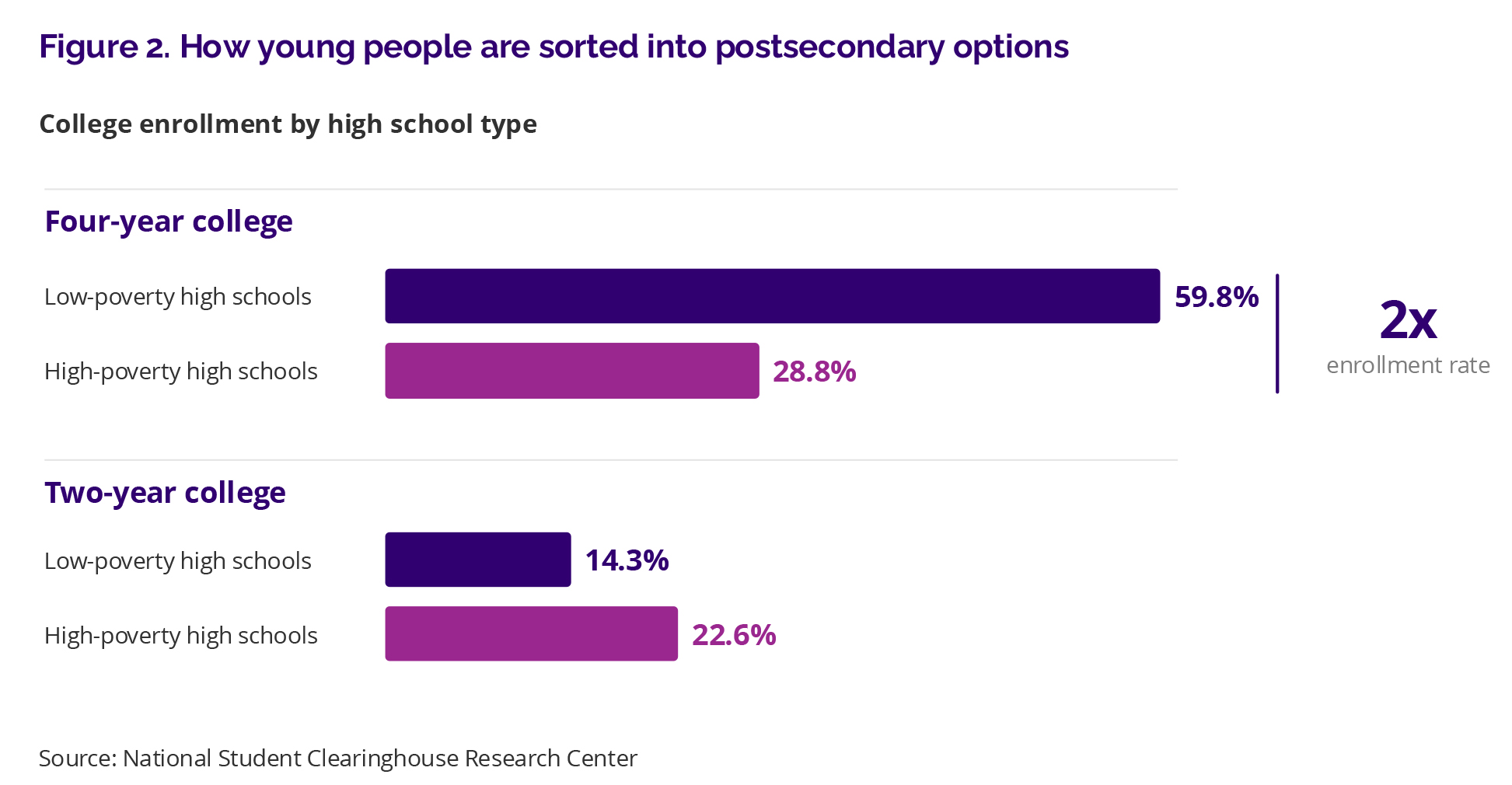
White students are disproportionately enrolled at selective colleges that provide resources to support bachelor’s degree completion and yield good economic outcomes for their graduates. This is where our narrative got something right: the evidence shows elite institutions serve as conduits for intergenerational wealth transfer and reproduce the very inequities that pathways seek to address. But building pathways that route young people who are the furthest from opportunity around those institutions rather than into and through them doesn’t disrupt that pattern. It reinforces it.
Meanwhile, Black and Latine students are overrepresented in short-term credential programs, where they are more likely to report experiencing discrimination than in associate’s and bachelor’s degree programs. The conclusion is clear: Black and Latine youth and young people experiencing poverty are diverted away from bachelor’s degrees that have demonstrated value in the labor market and an evidence base showing they contribute to numerous other positive life outcomes.
What’s more, steering young people toward credentials doesn’t just affect their first job. Credentials are intended to build and recognize technical skills for specific industries and occupations. That’s a problem in a rapidly changing labor market. For example, we’re old enough to remember when teaching young people to code was going to help them attain middle-skills jobs that paid family-sustaining wages. But AI has stepped in to do that work, precipitating closures of coding bootcamps and a spike in unemployment for computer science and engineering majors. Even if a student with a credential beats the odds and gets a highly paid job, their technical education wasn’t designed to build the skills needed for lifelong learning and career changes. Meanwhile, bachelor’s degrees deliberately instill durable skills—critical thinking, communication, complex problem-solving—through a general education that is more effective than narrow, vocational education at supporting career exploration and pivoting over a lifetime.
This is how privilege compounds. (We realize that things might be feeling more and more uncomfortable. For us, too. Stay with us. It’s going to get worse before it gets better.) Exploration is a developmental necessity during adolescence and creates the conditions needed for genuine choice and agency, but our strategies make opportunities for real exploration available to only a few. We’re pressuring the young people furthest from opportunity into early, narrow choices. We’re telling them to be “practical,” to take the shortest possible route to employment, and to accept that only young people born into affluent families get to explore and to access degrees that will open doors throughout their lifetimes.
Sarah Willie-LeBreton, president of Smith College, said what someone needed to say out loud: “I will confess that I’m always wary when any group of people that is highly educated and highly privileged decide that a whole other group of people don’t need the education that brought them their privilege and their status. I’m suspicious of that.”
We should be suspicious, too. Young people don’t see jobs as the destination. They’re seeking lives characterized by thriving, by which they mean having enough resources, having control over their time and labor, and being able to give back to their communities. The best available data shows that most bachelor’s degrees are more likely than most credentials to get them there. If equity is our goal, we cannot create “alternative pathways” to serve students of color and students experiencing poverty—especially when we know that the pathways we’re building won’t lead to the same outcomes as the system that serves more affluent students.
If equity is our goal, we cannot create “alternative pathways” to serve students of color and students experiencing poverty—especially when we know that the pathways we’re building won’t lead to the same outcomes as the system that serves more affluent students.
For young people without needed resources or guidance, the funhouse is disorienting in ways that build on each other. Every wrong door costs time and money. Every dead end makes the next choice feel higher stakes. And there’s no one to tell young people struggling to navigate it all which reflections to trust.
Our language saying that credentials are the pragmatic, achievable option has been steering some young people away from—or at least sending them down a path that makes it very hard to get to—the degrees that are most likely to help them achieve the lives they want. The reality is that we haven’t been expanding choice. That would look like doing the work it will take to understand which credentials truly lead to positive outcomes and which offer only false promises. It would mean building pathways that intentionally connect that first postsecondary credential to further postsecondary education, rather than relying on a vague notion of “stackable credentials” that the data says doesn’t play out in practice. It would mean designing systems that make bachelor’s degrees a real option for all students instead of sidestepping the access and completion issues associated with bachelor’s degree programs. And it would mean creating much better exploration opportunities and navigation supports so that young people have the information they need to assess a real set of choices and make decisions in line with their aspirations for their own lives.
Beyond the funhouse
We need to redesign pathways with doors that open and clarity about where they lead. We’re not arguing that everyone needs a bachelor’s degree or that we need to return to “college for all.” But we are arguing that pathways should offer real bachelor’s degree options for all young people who want them. And we need much more caution and precision in our approach to credentials, as well as a concerted effort to identify the ones that actually lead to positive outcomes.
For more than a decade, we’ve been working to build pathways that connect education to opportunity. But what we’ve built is a funhouse full of mirrors that distort reality, doors that lead nowhere, and a maze that’s nearly impossible to navigate. We told ourselves a set of convenient fictions about expanding opportunity. We fear we’ve been building something that forecloses it instead. The data is asking us to reckon with that.
That’s a hard thing to sit with, especially for those of us who helped build it. But this is not a counsel of despair. Confronting the evidence challenges our narrative, yes, but it also makes it possible for us to build something better.
We can’t do that, though, without understanding how we got here. Why did a pathways movement full of people who care deeply about equity end up creating a sorting mechanism that reinforces the very inequities we were trying to address? What narratives, incentives, and structural pressures led us to scale before we had evidence, to embed credential attainment in accountability systems before we understood outcomes, and to treat bachelor’s degrees as a risky bet while promoting credentials with far less evidence behind them? Why do some young people get real choices, while others get sorted into narrow, linear pathways? And, most importantly, what can we do differently?
In our next post, we’ll dig into some possible answers to those questions. For now, we’re sitting with the discomfort of what the data is telling us—and with the recognition that that discomfort is a necessary step toward building something different. We hope you’ll sit with it, too.
This post is part of All4Ed’s Normal Gets Us Nowhere series, which seeks to ask hard questions, spotlight fresh data and thinking, challenge longstanding assumptions, and offer new approaches that go beyond tinkering in order to contribute to the development of the next generation of pathways strategies. We don’t have all the answers about the right approach, and we are committed to working with both long-time pathways leaders and those new to the conversation to identify and test new ideas and strategies. If you’re working to build better pathways systems, we’d love to learn more and think about how we can work together, so please get in touch!

Stay in the loop
Our Normal Gets Us Nowhere blog series about all things pathways is just getting started. Sign up to get future posts and updates on how All4Ed is working with leaders across the country to build something better.
Meet The Authors

Charlotte Cahill
Senior Advisor
Kyle Hartung
Senior Advisor
Click here to go back to the blog series’ landing page.
