
Founded in 2001, All4Ed is a national nonprofit that drives transformation in education-to-career systems to ensure that every young person thrives in learning, work, and life. We work with federal and state policymakers, K-12 and higher education leaders, and cross-sector partners to advance equitable, learner-centered pathways organized around four domains of thriving: knowledge and capability, economic security and mobility, connection and belonging, and purpose and agency. Through policy advocacy and activation, technical assistance, and thought leadership, we move ideas from legislation to implementation, strengthen state and regional pathways ecosystems, and challenge assumptions about what pathways are for.
Featured Blog Series

Normal Gets Us Nowhere
Normal Gets Us Nowhere asks hard questions, challenges longstanding assumptions, and offers new approaches to pathways designed so all young people thrive in learning, work, and life.

Design Differently
The Design Differently blog series explores bold ideas, emerging practices, and real-world examples that help educators rethink how schools prepare learners for the future.

podcast | Accountability and Support, Congress, Education Policy, US Department of Education
All4Ed’s latest policy publications explore how federal and state policy can strengthen college and career pathways through expanded dual enrollment, Workforce Pell, and better data on college and career readiness.
podcast | Accountability and Support, Congress, Education Policy, US Department of Education
The Senate HELP Committee advanced bipartisan legislation to protect key Department of Education functions and improve literacy instruction through the READ Act. This episode of the All4Ed Flash explains what these votes could mean for students, schools, and education policy.
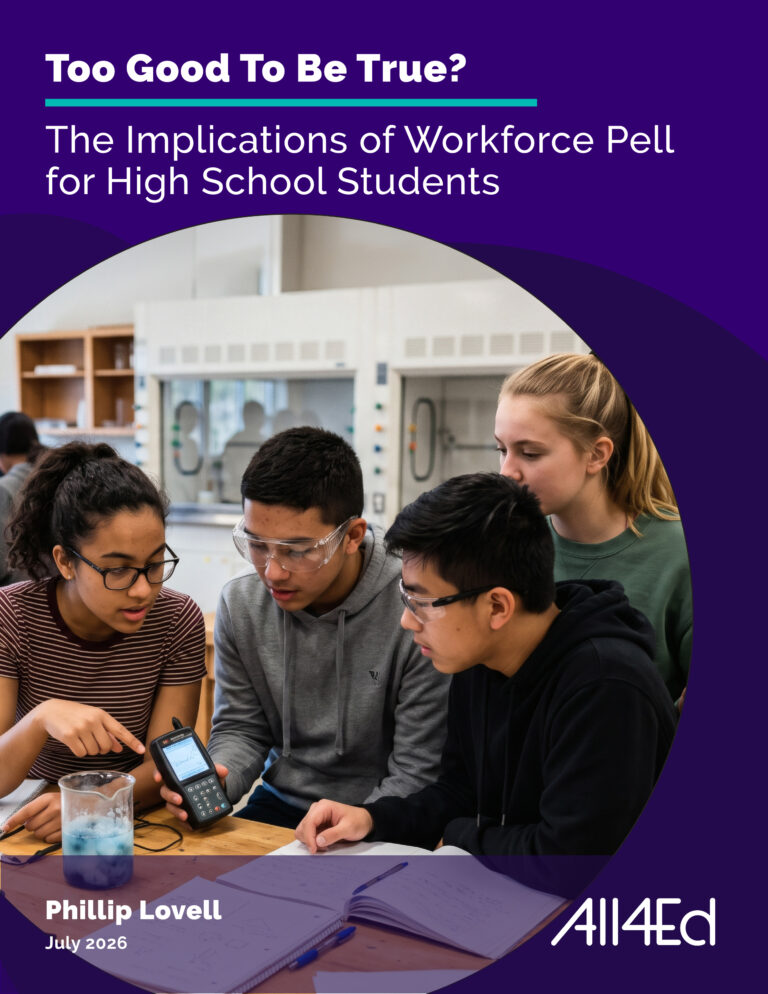
publication | Career and Technical Education, Education Policy, High Schools, Higher Education, Policy and Government
Can Workforce Pell expand opportunity without limiting students’ futures? This report examines how short-term workforce credentials could reshape K–12 education, college and career pathways, and counseling, while offering recommendations to protect long-term student success.
podcast | Accountability and Support, Congress, Education Policy, US Department of Education
Two major federal actions are reshaping education civil rights enforcement. This episode of the All4Ed Flash explains the end of MOA compliance monitoring, changes to Title VI disparate impact enforcement, and what they could mean for students and schools.
publication | Career and Technical Education, College and Career Pathways, Data, Education Policy
Explore how states can strengthen college and career readiness by connecting education data to real student outcomes. This report outlines how better longitudinal data systems can improve accountability, inform policy, and ensure pathways lead to success beyond high school.

publication | Career and Technical Education, College and Career Pathways, Congress, Education Policy, High Schools, Policy and Government
Where someone lives should not determine whether they get the chance to earn college credit before they graduate high school. But that is exactly what is happening today. Decades of research show that dual enrollment, the practice of allowing high school students to take college courses, is one of the most effective tools we have for closing college access and completion gaps. Participants are more likely to enroll in college, persist through their first year, and earn a degree, even after controlling for prior academic achievement. Still, access still depends heavily on zip code, family income, and the resources of a student’s school.
podcast | Accountability and Support, Funding Equity
What would the House’s “Less Bureaucracy, Better Education” legislative package mean for students and schools? This episode of the All4Ed Flash examines the proposed changes, the debate over moving OCTAE, and what’s next as the legislation heads to the full House.
podcast | Accountability and Support, Funding Equity
A proposed OMB rule could change how federal education grants are awarded and managed. In this All4Ed Flash, we explain what’s in the proposal, why All4Ed opposes it, and what it could mean for students, schools, and workforce pathways.
publication | Education Policy
Dr. Amy Loyd, President and CEO of All4Ed, submitted testimony to Democratic Members of the House Committee on Education and the Workforce regarding efforts to transfer the Office of Career, Technical, and Adult Education (OCTAE) from the U.S. Department of Education to the Department of Labor. Her testimony argues that career and technical education (CTE)…
