
Schrödinger’s Futures

The way pathways frame choice is a fiction.
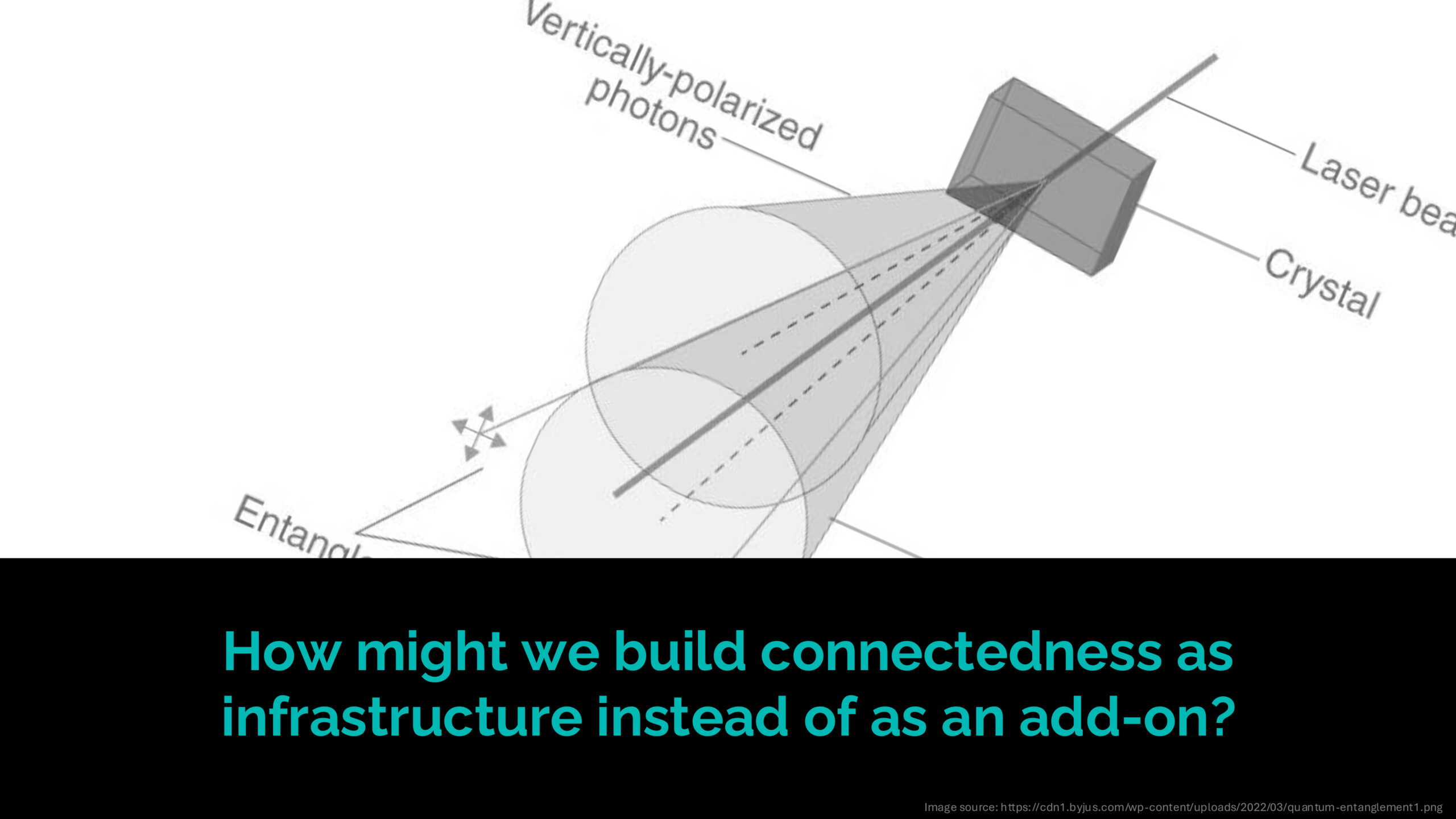
Pathways encourage young people to make a linear series of choices, but choice in adolescence is not linear. It contains uncertainty and possibility at the same time. Young people hold multiple possible futures in their heads at once. They’re thinking about becoming a nurse and starting a business and maybe being an influencer. That’s not because they’re indecisive or lack focus; it’s because that’s what they’re developmentally wired to do. Like Schrödinger’s cat—which in quantum mechanics exists in superposition, in multiple states that blend all possibilities at once until observed—young people exist in a state of possibility, holding multiple potential selves, careers, and identities at once. We’re calling this state Schrödinger’s futures. (Why yes, it does take a special kind of nerdiness to invoke a quantum mechanics metaphor. We’re here for that.)
Here’s the thing: the superposition of multiple futures isn’t a problem that we need to solve. It’s a feature of healthy adolescent development. But we’ve built systems that pressure young people to collapse their quantum state of possibility into an outcome defined by a single linear pathway.
We tell young people they have to choose “correctly” before they have the information, experience, developmental capacity, or inclination to do so. We call this “choice,” but real choice requires the availability of genuine options. What we’ve actually built is a high-stakes sorting mechanism dressed up in the language of opportunity. Pathways are too often designed so that when young people inevitably need to course correct—because that’s what exploration actually looks like—they run into dead ends instead of structures that support the type of non-linear growth that comes with changing direction.
In our last post, we argued that designing pathways to meet employer demand leads to treating young people as workers in waiting instead of as whole humans. Rather than starting with questions about how we can build strong talent pipelines, what if we asked something more like: “How can we backward map pathways from young people’s visions for their own futures?”
We realize this might sound like we’re proposing to turn more than a decade’s worth of carefully crafted pathways strategies on their heads. (We sort of are.) But just hear us out.
Pathways need to be designed to hold a tension: youth need both the agency to define success on their own terms and the skills and credentials the data tells us are required to access economic opportunity. These goals are interdependent and mutually reinforcing. Pathways that force young people to make premature choices aren’t developmentally appropriate or responsibly designed. And worse, they risk systematizing inequity by forcing the young people furthest from opportunity into narrow pathways while their more affluent peers have access to the support it takes to explore all of the options available to them.
The fiction of choice
To help us imagine how we could do better, we wanted to understand more about what would work for young people. Armed with curiosity and our trusty degrees in the humanities, we waded into some of the research on the science of adolescence and youth development to try to understand what pathways calibrated to the reality of young people’s needs might look like.
We quickly saw that pathways would need to contend with the fact that adolescence isn’t a dress rehearsal for adulthood. Decades of work in developmental science have shown that adolescence stretches deep into one’s twenties and is a distinct developmental stage focused on identity formation, experimentation, and figuring out who one can—and wants to—be. Here are just a few of the other things we learned, organized by broad area of research:
IDENTITY FORMATION
- What the research says: During adolescence, our sense of who we are becomes more integrated and stable, and we create a positive sense of self and belonging based on our values and aspirations. Identity development includes occupational identity formation, which encompasses young people’s visions of their future selves in the workforce, nurturing and exploring skills of interest, and considering where they feel a sense of belonging.
- What it means for pathways: Forcing early choices cuts short the exploration process that builds healthy identity.
EXPLORATION AND RISK-TAKING
- What the research says: Adolescent brains are wired for exploration, novelty-seeking, and social learning. Tolerance for uncertain outcomes—and willingness to take risks—is an essential part of learning in adolescence.
- What it means for pathways: Pathways that try to eliminate uncertainty or create pressure to make early decisions work against the way adolescents actually learn and develop.
CONTRIBUTION AND SENSE OF PURPOSE
- What the research says: Sense of purpose develops through making meaningful contributions to communities, families, and peers—and then reflecting on those contributions.
- What it means for pathways: Pathways need to offer real opportunities to contribute and reflect, not just focus on skill development.
HOW YOUTH THINK ABOUT THE FUTURE
- What the research says: Young people ask “How do I want to live?” not “What do I want to be?” They think about their futures across multiple states: surviving, striving, and thriving.
- What it means for pathways: Career-centered framing misses how youth actually conceptualize their futures. Salary data alone won’t motivate them.
DEVELOPMENTAL RELATIONSHIPS
- What the research says: Developmental relationships support healthy identity formation and navigation and include five critical elements: express care, challenge growth, provide support, share power, and expand possibilities.
- What it means for pathways: Relationships aren’t a nice-to-have; they’re core pathways infrastructure. Pathways must deliberately support young people in cultivating them.
NETWORKS AND SOCIAL CAPITAL
- What the research says: Social capital includes the quantity, quality, and variety of networks young people have, plus the ability to mobilize them. Cross-class friendships are among the strongest predictors of economic mobility. Relationships aren’t just inputs that help youth succeed; they’re outcomes in their own right.
- What it means for pathways: Sporadic mentorship and job shadow days won’t cut it. Connectedness should be a primary outcome of pathways, not an afterthought.
That’s a lot of research—and we’ve only scratched the surface of what’s out there. The short version of what we’ve learned is this: adolescents need space to explore multiple identities, real opportunities to contribute and build a sense of purpose, and genuine, supportive relationships. They need systems that allow for uncertainty instead of trying to eliminate it. So how did we end up with a set of pathways strategies that don’t address these developmental needs?
Pathways got their start as choice architecture intended to support navigation through a maze of education and career options, kind of like the arrows on the floor in an IKEA store that create a one-way path through the showrooms. It’s a layout that propels you forward and makes it hard to change course—if you realize while you’re enjoying your meatballs in the cafeteria that you forgot to check out the bookcases, it’s annoying and difficult to backtrack. Pathways are constructed in a similar fashion. They began as a way to help young people navigate confusing and disjointed systems. But their focus on doing so while efficiently accelerating young people toward specific careers is misaligned with what the research on youth development tells us. Pathways designed for the developmental needs of young people should provide structure, but that structure should allow young people to keep their options open during a stage of life that’s marked by a need for exploration and risk-taking.
Young people are navigating systems that limit their room to experiment and grow. And when youth inevitably need to correct course—because that’s what healthy exploration looks like—the system treats it as failure rather than learning. Our systems reward choosing early, not necessarily choosing wisely.
Our failure to build pathways calibrated to what developmental science tells us is how we’ve ended up with the fiction of choice. We pretend young people have limitless options while quietly structuring programs that create narrow tracks with very real dead ends and that foreclose possibilities before youth have adequate information or self-knowledge. Pathways strategies that reduce choice rather than redesign systems end up funneling youth into pathways that collapse possibility instead of expanding it, selling “no dead ends” snake oil, or creating the illusion that early choices are reversible, when in reality—because of our siloed and rigid systems—they are not. The real problem isn’t young people’s motivation, maturity, or “readiness.” The problem is pathways strategies and systems that are built on the wrong premises, center employer demand instead of youth, measure efficiency while ignoring development, and treat exploration as a detour, not as the point.
Strategies that reduce choice rather than redesign systems end up funneling youth into pathways that collapse possibility instead of expanding it.
So if our current approach—early choices, targeted focus on careers, and sporadic connections—isn’t developmentally appropriate, what would be? We still think that we need an urban planning approach that’s intentional about designing less linear pathways that intersect and offer multiple routes to a variety of destinations, with options for a detour in case of construction. (And of course there’s always construction.)
How might we design pathways differently?
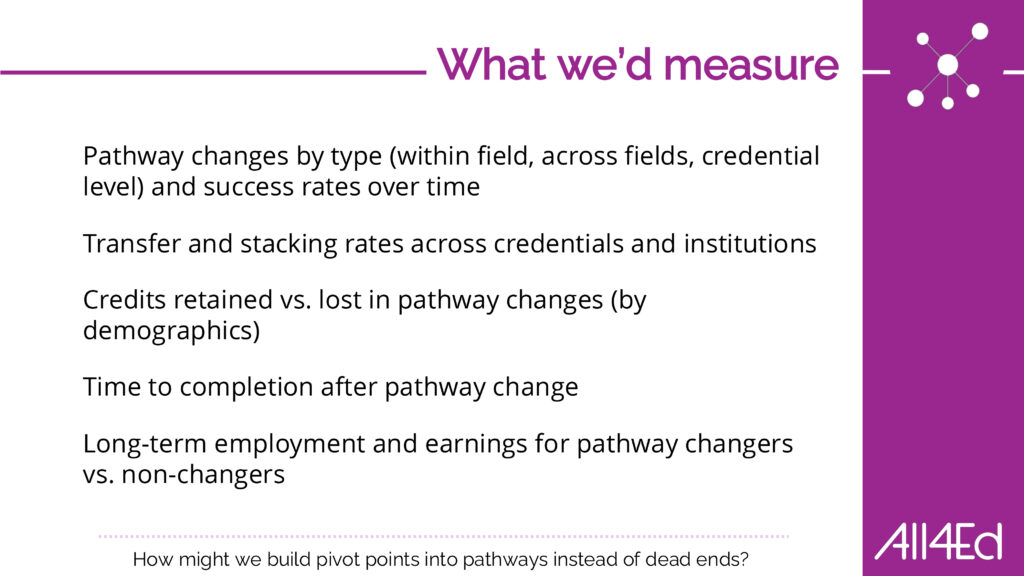
We’re now four installments into this series, and we’re keenly aware that we’ve offered more critiques than constructive ideas about what we might do differently. So we tried out a move from diagnosing challenges to getting curious about what solutions might look like, beginning with thinking more expansively about the outcomes we hope pathways will achieve. We believe we need pathways that support young people in building lives defined not just by employment—or even economic security—but by meaningful relationships and connections, agency, choice, purpose, and belonging. That would mean measuring outcomes that include not only credential completion, skills, and job placement, but things like pathway flexibility, the availability of multiple options, and the quality of young people’s professional networks.
We turned for help to a tool used in design thinking, which is an iterative and human-centered approach meant to solve complex problems through a collaborative and experimental process. This process often involves “how might we…” questions, which is design-thinking jargon for questions that are meant to reframe problems and encourage brainstorming about solutions. We posed three such questions grounded in the research we’ve explored.
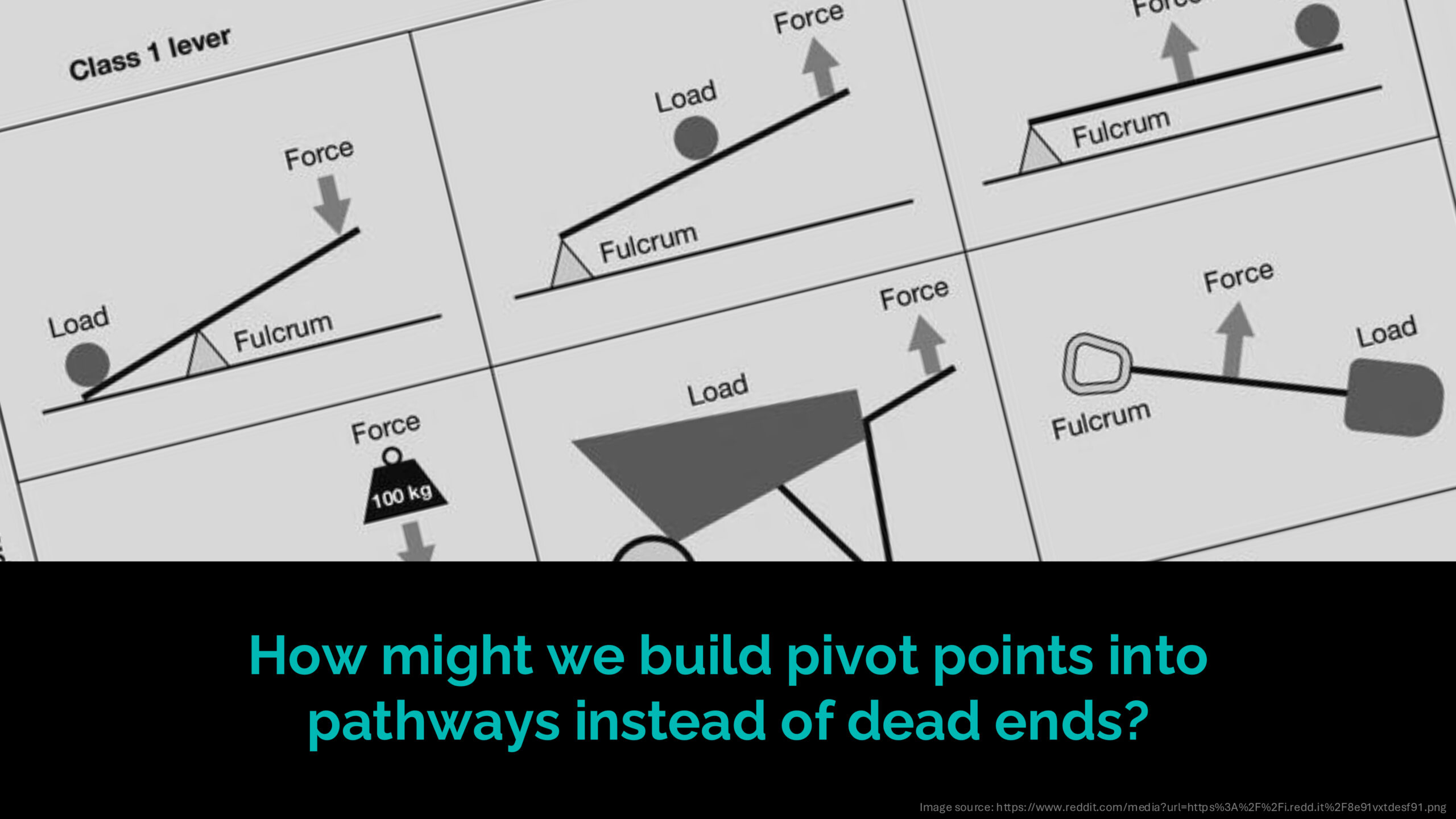
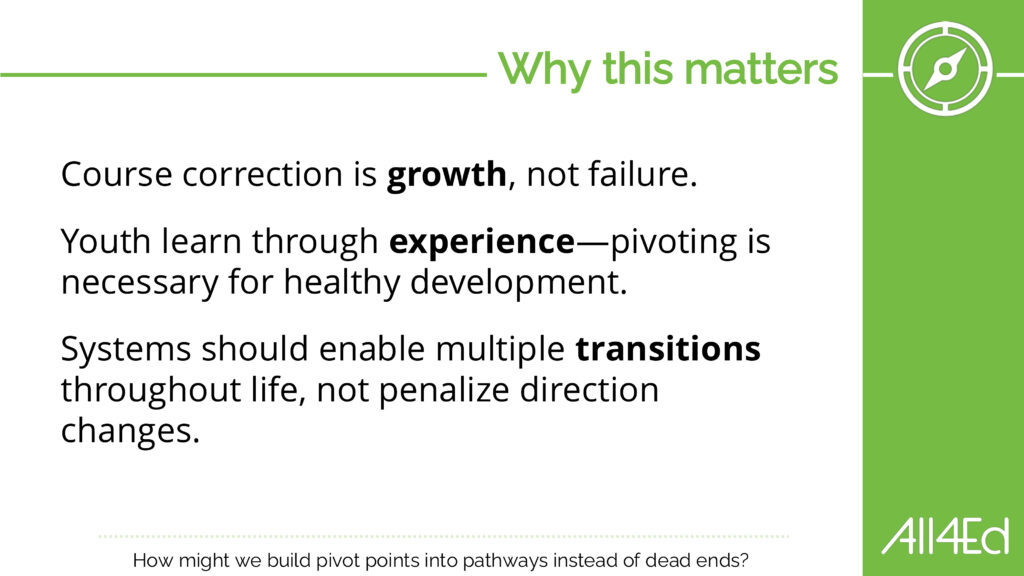
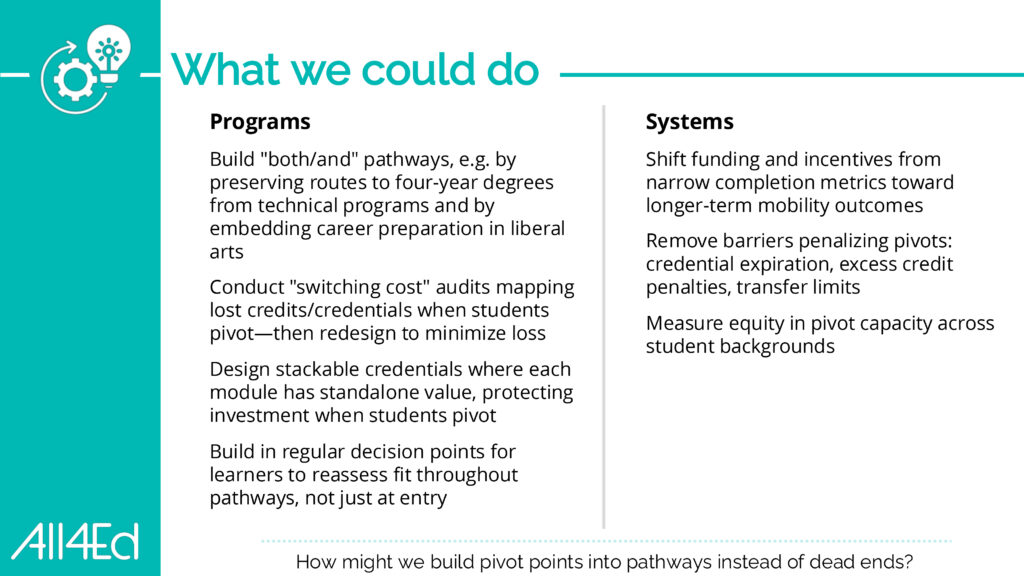
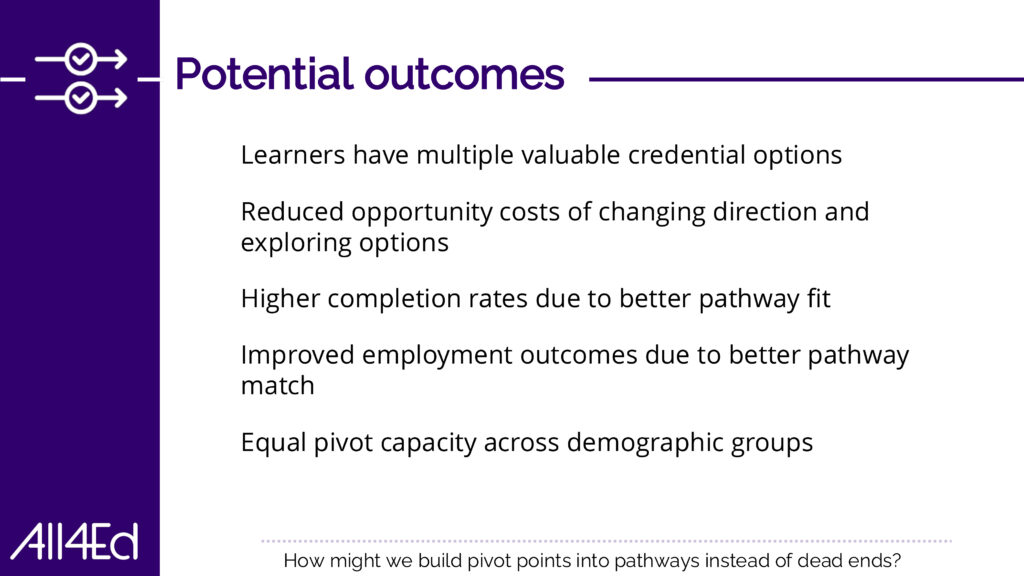
- How might we build pivot points into pathways instead of dead ends?
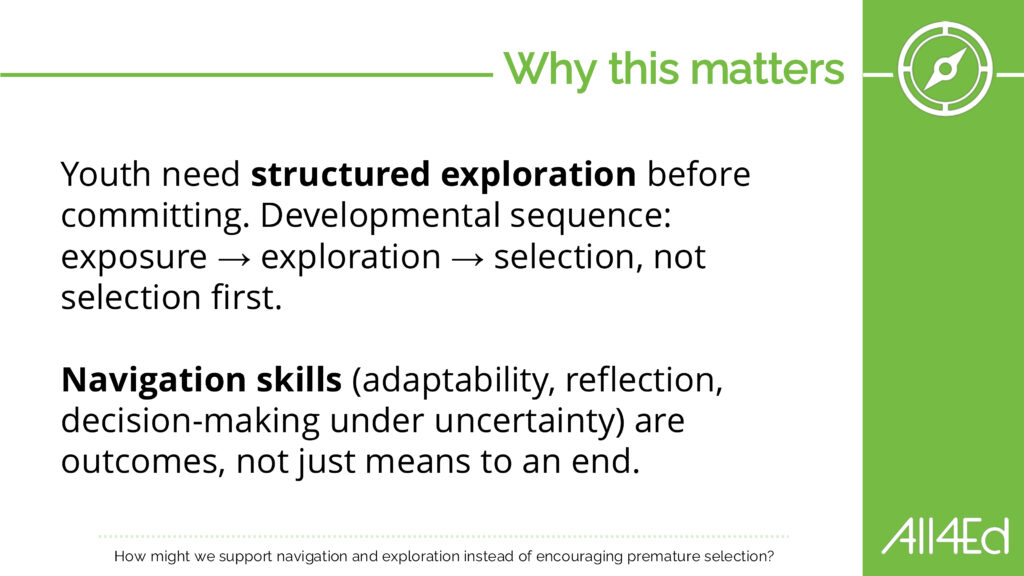
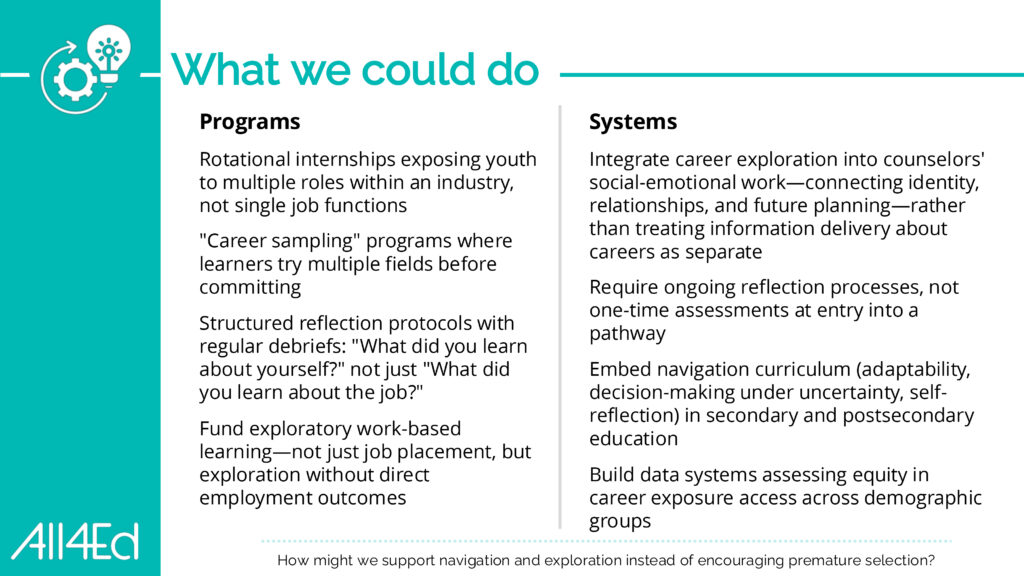
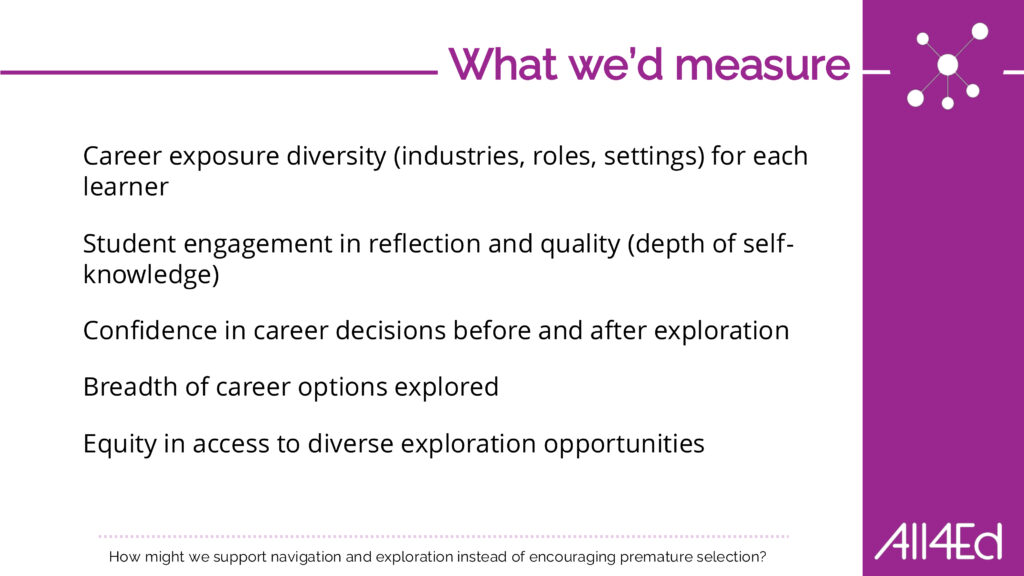
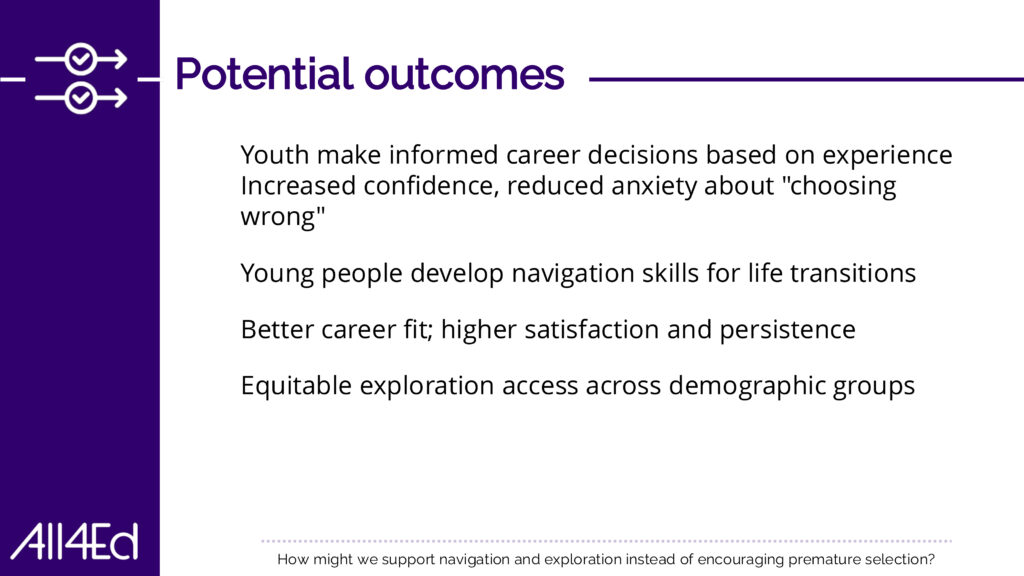
- How might we support navigation and exploration instead of encouraging premature selection?
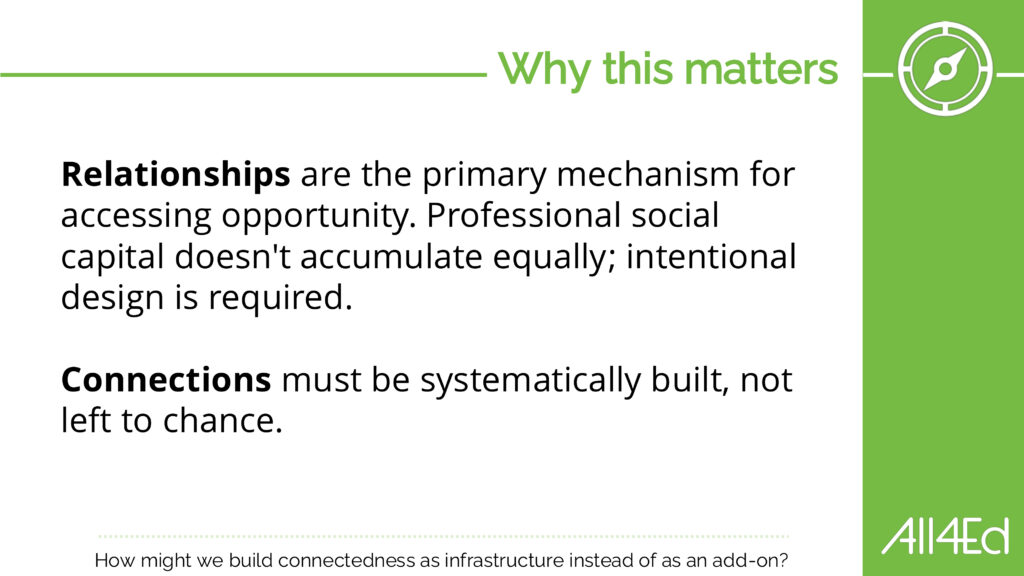
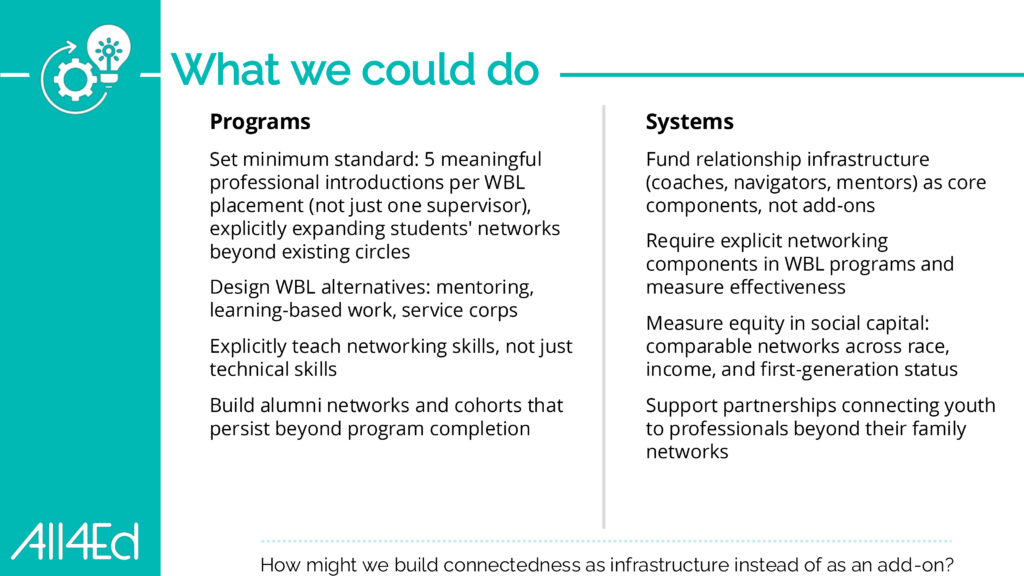
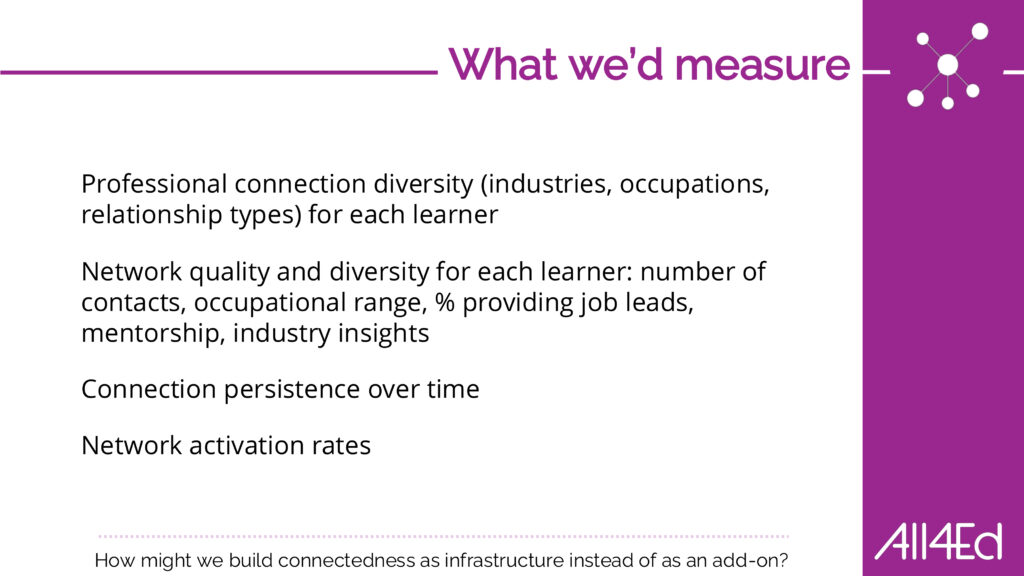
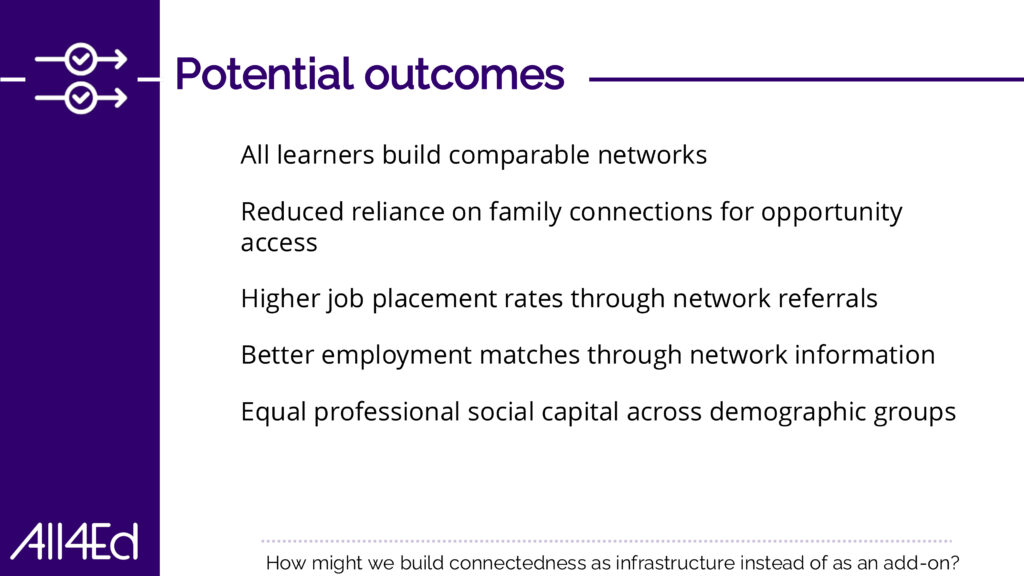
- How might we build connectedness as infrastructure instead of as an add-on?
For each question, we’ve sketched out below some preliminary thinking in something akin to a theory of action that speaks to why this matters, what we could try doing differently, what we could measure, and what outcomes we might achieve. These aren’t definitive answers, but they feel like a productive place to start.
Superposition as a strategy
The key point about quantum superposition is that observation collapses possibility because the measurement itself changes the outcome. But our pathways systems demand exactly that measurement when they ask young people to choose now—and choose correctly the first time. This approach essentially builds an elaborate infrastructure that undermines the quantum state of youth. It’s as though we’re demanding not only to know whether Schrödinger’s poor cat is alive or dead, but that it also provide us with a thoughtful articulation of its occupational identity.
Strategies that embrace superposition instead of trying to correct for it are both developmentally appropriate and critical to ensuring pathways are equitable. Young people from affluent families have the support—and freedom—they need to explore and try again when things don’t work out. They can pivot and take advantage of gap years, career changes, and opportunities to “find themselves.” Meanwhile, the young people who are the furthest from opportunity feel pressured to choose early and choose “right” because we tell them that only those with financial resources get to explore and make mistakes. We need pathways systems that treat exploration as the developmental necessity that it is, not as a luxury good accessible to a select few.
We’ve offered some tentative ideas about how we might do things differently, but we don’t yet have
We need pathways systems that treat exploration as the developmental necessity that it is, not as a luxury good accessible to a select few.
comprehensive solutions. We’re still learning and hope the ideas in this post might represent a starting point for designing pathways backward from what young people actually need. Some of these changes are program-level and can start tomorrow. Others require policy shifts that’ll take years.
We’re determined to take accountability for doing something about this rather than placing the burden on young people to navigate systems that weren’t designed for them. The question isn’t whether they can handle choice—it’s whether we can build pathways that offer it for real.
This post is part of All4Ed’s Normal Gets Us Nowhere series, which seeks to ask hard questions, spotlight fresh data and thinking, challenge longstanding assumptions, and offer new approaches that go beyond tinkering in order to contribute to the development of the next generation of pathways strategies. We don’t have all the answers about the right approach, and we are committed to working with both long-time pathways leaders and those new to the conversation to identify and test new ideas and strategies. If you’re working to build better pathways systems, we’d love to learn more and think about how we can work together, so please get in touch!

Stay in the loop
Our Normal Gets Us Nowhere blog series about all things pathways is just getting started. Sign up to get future posts and updates on how All4Ed is working with leaders across the country to build something better.
Meet The Authors

Charlotte Cahill
Senior Advisor
Kyle Hartung
Senior Advisor
Click here to go back to the blog series’ landing page.
