
Did Busing Work?
In the years after the Brown vs. Board of Education decision, school districts turned to busing students to achieve racial diversity. Today, sixty-five years after the Brown decision, did busing work? What do research and advocates say about busing, its impact, and possible solutions for an education system in which many U.S. schools are more segregated today than they were decades ago?
Writing for Chalkbeat, Matt Barnum notes that Democratic presidential candidates Senator Kamala Harris and former Vice President Joe Biden “catapulted a long-running debate about busing and school integration back into the news.” But did busing work? Barnum acknowledges that school segregation dropped “substantially as courts and the federal government put pressure on local districts to integrate, but those efforts also sparked bitter, sometimes racist, resistance that shaped political discourse for decades.”
Writing for the Boston Globe columnist Jeff Jacoby writes that Boston was home to the “ugliest antibusing backlash in the nation.” He notes that photographer Stanley Forman won a Pulitzer Prize for “The Soiling of Old Glory,” a photograph of a white teenager assaulting a black man with a flagpole holding the American flag.
“Busing made everything worse,” Jacoby writes. “Public school enrollment plummeted. In Boston, 78 school buildings were closed. In 1970, 62,000 white children attended the city’s public schools—64 percent of the total. By 1994, only 11,000 white students remained. Before busing began, the average black child in Boston attended a school that was 24 percent white. By the mid-1990s, the proportion was 17 percent. Far from reducing racial isolation, busing had intensified it.”
In his video, embedded below, for the Alliance for Excellent Education’s #OurChallengeOurHope video series, Education Trust President and former U.S. Secretary of Education John King notes that many U.S. schools are more segregated today than they were ten or twenty years ago.
Not only are schools more segregated today, some small, affluent communities are actively trying to carve out school districts for their communities from within larger school districts. In “Fractured: The Accelerating Breakdown of America’s School Districts,” EdBuild notes that more than 125 communities have attempted to “secede” from their school districts since 2000. Of those, more than seventy have been successful.
“Why the constant changes?,” EdBuild asks. “In large part, because American school districts are funded substantially out of local property tax dollars. This ties school budgets to local wealth levels—and that means great rewards for those who can redefine ‘local.’ When district boundaries are redrawn, and in particular when a small, affluent community fences itself off, those on the fortunate side of the line can keep their tax revenues just for their hyperlocal schools. Meanwhile, those on the outside are often left with fewer resources for a needier student population.”
In an interactive map, EdBuild explores how communities across the United States have seceded or are attempting to secede from their school districts.
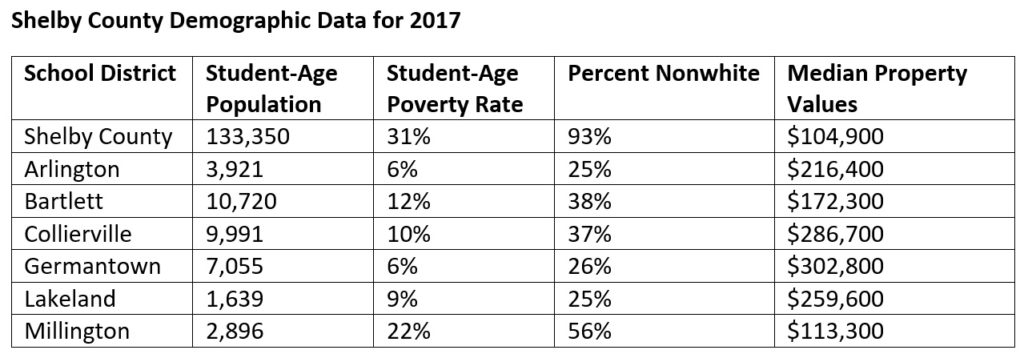
On such case study spotlights Memphis, Tennessee, where six suburbs voted to leave Shelby County Schools. Today, Shelby County Schools serves students living in the city of Memphis and the unincorporated areas of the county. As the EdBuild data in chart below demonstrates, the remaining students in Shelby County Schools are 93 percent nonwhite while the median property value is $104,900, or one-third that of Germantown Municipal School District.
Source: EdBuild
So what’s the solution? Writing in Slate, Sherrilyn Ifill, president of the NAACP Legal Defense and Educational Fund, notes that the busing debate on the presidential campaign trail has “reignited the most resilient and pernicious myths about busing and school desegregation, myths that continue to thwart this country’s efforts to fully achieve the goal of school desegregation.”
Ifill argues that we “do not have to continue to live with the consequences of past opposition to desegregation” and she outlines several roles that school districts and government can play.
“The trend line of increased school segregation can be reversed by school districts using all available means to combat segregation. This includes, but is not limited to, the use of magnet schools, busing, voluntary student transfers, and zoning. The nation must address the extensive residential segregation, created in large measure by governmental policies and practices, through aggressively enforcing fair housing laws, reducing exclusionary zoning, increasing inclusionary zoning, increasing subsidies for affordable housing in high opportunity areas, and providing financial support for efforts to improve the mix of persons by race and economics in communities that are currently segregated on the basis of race and income.”
She concludes with a message that everyone, everywhere–from small, affluent communities to the White House–should hear:
“If anything is evident since the 2016 presidential election and ensuing events, it is that racial division weakens our nation. As our country fractures before our eyes, it is past time that Americans stop embracing faux justifications for racial segregation and recognize that it has devastating consequences for our national security and cohesion—and our integrity as a democracy.”
You’ve heard from the experts. We want to hear from you. What should we do locally and/or nationally to erase the negatives of busing and combat the segregation that festers in so many schools today? Please share your thoughts in the comments section.
And to learn more about the educational and societal challenges still facing our country today–sixty-five years after Brown vs. Board of Education–visit #OurChallengeOurHope, our equity campaign to honor the Brown decision and shine a light on the continuing needs of students—no matter their race, zip code, or background.
Jason Amos is vice president of communications at the Alliance for Excellent Education.
