Programs Get Students In the Door. Purpose, Belonging, and Social Capital Keep Them Moving.
A new national report from the Commission on Purposeful Pathways, A Launchpad for Life, is worth your time. It offers a lens that I think will challenge the way many of us evaluate our district’s pathways work, and it should.
The Commission makes the case that the programs most districts are building, which include career advising, work-based learning, with early college opportunities mixed in, are necessary, but they’re not enough. What actually determines whether those programs change the trajectory of a student’s life comes down to three things: purpose, belonging, and social capital. In fact, one of the Commission’s four core recommendations is to hardwire all three into every pathway. The report illustrates it this way (p. 18):
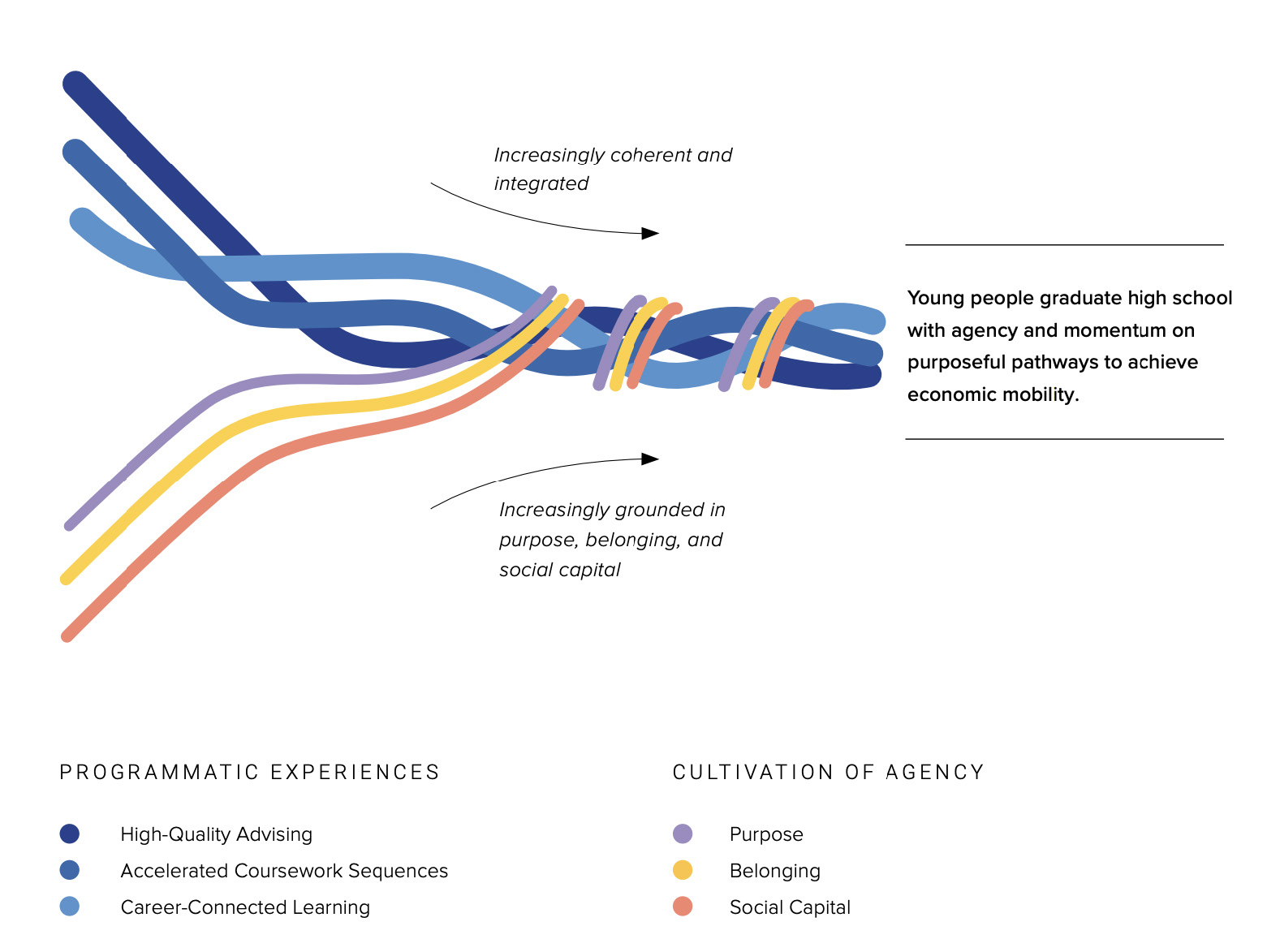
Process that for a moment.
That notion is one of the main reasons we built Future Ready Pathways. Not as another framework to add to the pile, but as a practical toolkit to help district leaders move from scattered initiatives to a coherent, career-connected system grounded in real outcomes; one that asks the hard questions, closes real gaps, and keeps each learner at the center.
To support this challenge, here are three questions to bring back to your leadership team for some honest dialogue:

Purpose
1. Where in your K-12 experience are students given structured time to reflect on their interests, strengths, and life goals, not just their next set of course plans?
Many districts have strong pathway structures on paper. Students may be enrolled in dual-enrollment courses, completing job shadowing, and earning credentials. But when you actually talk to those students, can they tell you why it matters to them personally? Can they connect what they’re learning to something they genuinely care about?
Purpose isn’t something our learners inherently show up with. It’s something we have to intentionally cultivate through structured reflection, identity exploration, and developmentally appropriate experiences that build over time. Future Ready Pathways points to starting this work in the early grades, using tools like the RIASEC interest framework to help young learners understand who they are, what they enjoy, and how it connects to the world of work, a decade before they’re asked to choose a direction. By the time students reach high school advising conversations, purpose-building should already have years of foundation beneath it.

Belonging
2. Do your students feel like they belong in the spaces your pathways lead them to?
Purpose gives learners a reason to move forward. But if they don’t feel they belong in the spaces your pathways lead them to, that momentum disappears fast.
Think about the student who earns a seat in a dual enrollment course and shows up in that college course for the first time, excited, maybe a little terrified, only to quietly conclude within weeks that this place wasn’t built for someone like her. Or the student who completes a work-based learning experience with real skill and real effort, but never gets called back. Not because he underperformed. Because no one taught him how to follow up, how to introduce himself to the right person, or how to read a room he’d never been in before.
These learners didn’t fail the pathway. The pathway failed to bring them all the way in. Belonging isn’t automatic, and it has never been equally distributed.
The Commission’s report cites research showing that a student’s sense of belonging is a meaningful predictor of degree attainment, and that it matters especially for first-generation students, students of color, multilingual learners, and students with disabilities. Future Ready Pathways centers this through recommendations and discussions around near-peer mentoring, culturally responsive advising, employer partnerships that prepare supervisors to meaningfully support young interns, and services that remove practical barriers to participation.
And that gap doesn’t fall evenly.

Social Capital
3. Are your pathways actively building students’ professional networks or leaving that to chance?
Research suggests that up to 70% of jobs are never publicly posted. Who students know and whether they have the skills and confidence to activate those relationships are among the strongest predictors of economic opportunity. Yet many pathway programs treat networking as a byproduct rather than a core value.
The student whose parent works in a professional network, who grew up attending industry events, who has a family friend who can make a phone call to a local executive or business owner — that student arrives at adulthood with an invisible infrastructure that no transcript reflects, and no credential can replace. For students without those connections, albeit the majority of students, the hidden job market stays hidden. If we’re serious about equity, we can’t leave social capital to family circumstances. It has to be intentionally designed into the system.
Future Ready Pathways treats social capital as a core design principle. That means structured career conversations with industry professionals, community partnerships that connect students to adults outside their immediate circles, and advisory systems that extend beyond graduation into postsecondary transitions. It also means helping students map and reflect on the networks they already have, making the invisible visible.
Putting It Together
Purpose, belonging, and social capital don’t replace the structural work of building robust pathways. They make that work count. Future Ready Pathways provides the framework — four interconnected pillars of Education and Career Navigation, Dual Enrollment, Work-Based Learning, and Industry-Recognized Credentials — grounded in a K-12 experience of Career-Connected Exploration, built to center student identity, equity, and real-world outcomes from the start.
Every student deserves a pathway that doesn’t just point them toward a future but actively prepares them to claim it. If these three questions surfaced some gaps in your team’s work, that’s not a reason for discouragement. It’s a reason to keep moving forward for the kids we serve!
Explore the full Future Ready Pathways toolkit at futurereadypathways.org, and read the Commission’s full report, A Launchpad for Life, at educationfirst.com.
