
Assessing the Assessments: 2026 State Bills on Summative Assessments
Last summer, I wrote about a wave of state bills aimed at scaling back statewide summative assessments. Many of those proposals risked undermining the comparable, standards-aligned data that families, education leaders, and policymakers rely on to identify gaps in learning and school quality. In the 2026 legislative session, that wave is still building. In fact, a new federal context has bolstered these efforts and broadened the range of approaches state legislatures are willing to try.
In July 2025, the U.S. Department of Education (the Department) issued a Dear Colleague letter encouraging states to seek waivers from Every Student Succeeds Act (ESSA) requirements, including assessment and accountability requirements, reflecting the administration’s broader push to return education decision-making to states. Since then, a handful of states have submitted waiver requests or posted draft waiver requests for public comment. While the Department has approved two waiver requests to date, neither of these states (Iowa and Louisiana) requested changes to their assessment systems, so it is unclear how much flexibility, if any, states will receive if state legislatures enact laws that alter statewide assessment systems or reduce alignment with federal assessment and accountability requirements. The Department has signaled that it does not intend to waive accountability or assessment requirements wholesale, but it remains unclear how it will respond when state legislation directly conflicts with ESSA’s expectations for statewide, comparable assessment systems.
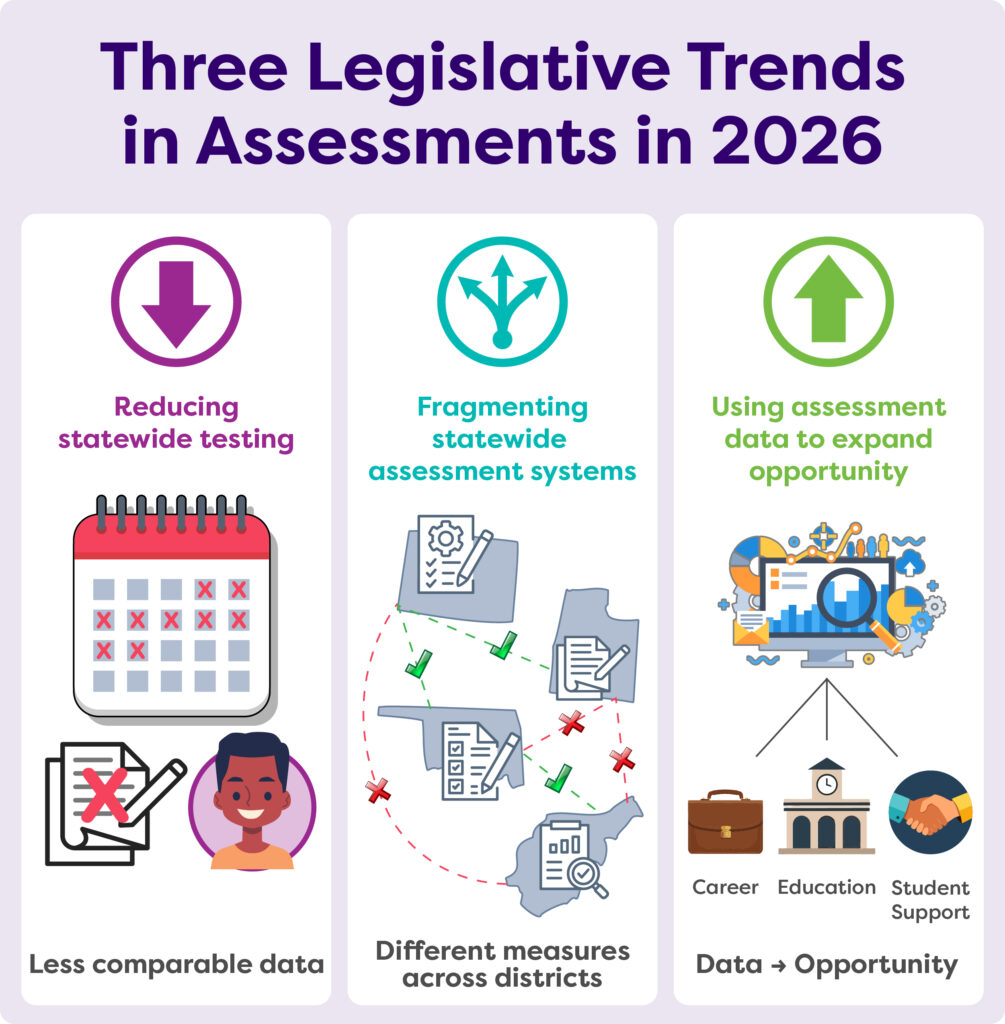
Against this backdrop, this year’s state assessment bills fall into three trends, two of which are concerning: (1) reducing statewide testing and (2) fragmenting statewide assessment systems by providing a menu of options. A third trend, which is more encouraging, shows how some states are moving to use summative assessment data to expand opportunity and target resources to students who need them most.
Reducing statewide testing to the federal floor and beyond
The push to scale back statewide summative assessments isn’t new. What’s notable in 2026 is the range of approaches lawmakers are taking. ESSA requires states to give statewide summative assessments to all students in English language arts (ELA) and math annually in grades 3-8 and once in high school. The law also requires states to administer tests in science once in grades 3-5, 6-9, and 10-12.
At the most aggressive end, West Virginia HB 4077 (failed) would have eliminated all standardized tests in all public and private schools beginning in the 2026-27 school year. As written, it would have put the state out of compliance with ESSA and at risk of losing federal funds. Oklahoma HB 4174 (failed) took a more measured approach by requiring that the statewide student assessment system “not exceed federal minimum assessment requirements.” Similarly, Colorado SB 26-068 (failed) would have required the state department of education to “ensure that standardized summative assessments are administered to students to the minimum extent possible” and to seek a federal waiver if necessary. Both bills aimed to test only what the federal law requires, and nothing more.
These bills reflect a growing appetite among lawmakers to treat ESSA’s testing floor as a ceiling, often at the cost of the comparable, standards-aligned data that families, education leaders, and policymakers rely on to identify learning gaps and target resources where they are needed most.
Fragmenting statewide assessment systems


While ESSA permits some district-level assessment variation, the flexibility is fairly narrow. At the high school level, ESSA allows states to let districts choose between the state assessment and a nationally recognized test, as long as the alternative meets all federal requirements. However, several bills would push well beyond that boundary.

Utah HB 234 (failed) would have created a five-year pilot program, the Alternative Statewide Testing Pilot Program, to allow participating school districts to select and administer a nationally norm-referenced assessment in place of Utah’s standards-aligned summative assessment in ELA, math, and science. Criterion-referenced assessments measure whether students have mastered state-defined academic standards. Norm-referenced tests, on the other hand, compare a student’s score to those of other students, assigning percentile rankings as opposed to evaluating mastery of specific grade-level content. If passed, this bill would have left parents, education leaders, and policymakers without clear information on whether students are meeting grade-level expectations.
And by allowing districts to use different tests, it would have made it effectively impossible to compare school quality and student learning across the state.
At the high school level, similar fragmentation was proposed in a few states. For example, Oklahoma SB 1897 (failed) would have allowed each school district to select its own high school assessment from a menu of state-approved options, while SB 1298 (failed) would have directed the state department of education to identify at least three alternative assessments districts could choose from to satisfy ESSA’s high school testing requirements. On a more extreme end, South Dakota SB 167 (failed) would have gone further by giving individual students the choice of which high school assessment to take.

This is not a new attempt. The Department rejected Arizona’s request to let districts select between the ACT and SAT, citing comparability concerns, and warned that Arizona’s planned menu of assessments for grades 3-8 would fail to meet federal requirements. The concern was straightforward: not all assessments are created equal. A menu of non-comparable assessments creates serious equity concerns: students from certain student groups can be disproportionately steered toward less rigorous tests and held to lower expectations, while families can lose the ability to know whether their students are meeting state-defined grade-level standards. Simply put, flexibility should not come at the expense of the comparable, standards-aligned data that surfaces gaps in learning across student groups, schools, and districts.
Using summative assessment data
While many of the bills above would scale back statewide summative assessments, some bills moved in the opposite direction, aiming to use assessment results to strengthen learning, expand opportunity, and target resources to students who need them most.
North Carolina HB 832, which already passed both chambers, would expand the state’s existing automatic enrollment policy for advanced courses to include ELA, ensuring that students who score at the highest level on the end-of-grade test are placed in advanced ELA coursework the following year. This bill would use summative assessment data to ensure that students from underrepresented backgrounds aren’t overlooked when the data shows they are ready for more rigorous coursework. Similarly, Iowa SF 2220 (enacted) requires districts to automatically enroll students in grades 4-12 in advanced math or ELA if they score at the advanced performance level on the statewide summative assessment. While North Carolina and Iowa aim to use assessment data to expand opportunity for high performers, other bills would use the same data to direct support to students who are struggling. For example, New Mexico SB 233 (failed) would have required schools to provide students with high-impact tutoring if they score in the bottom quartile on statewide assessments for ELA or math.



Ohio SB 19, which passed the Senate and is now pending in the House, would use summative assessment results to drive several coordinated supports, particularly in math. Students who score below proficient on state math or ELA assessments would receive free academic intervention services, including high-dosage tutoring, extended learning time, and other targeted supports. Seventh graders who score at accomplished or advanced levels on the state math assessment would be automatically enrolled in accelerated math or Algebra I courses the following year. Additionally, districts where 51% or fewer of third graders score proficient in math would be required to develop achievement improvement plans aligned to high-quality curriculum, ensuring leadership-level accountability and strategic intervention.
The 2026 legislative session shows a clear divide. Some bills would reduce or fragment the summative assessment systems states rely on to understand student learning and progress, while other bills use the same assessment results to expand access to advanced coursework and target resources to struggling students. Both trends are unfolding alongside a growing wave of ESSA waiver requests. How states resolve this legislative divide and how the Department responds to waiver requests will together shape not only the future of statewide assessment policy, but the extent to which parents, education leaders, and policymakers can see clearly how every student is being served by our public education system.
As All4Ed continues to track the remaining legislative sessions in 2026, our State Policy Center features model legislation for policymakers and advocates on college and career pathways, digital equity, and next generation accountability. Continue to check the State Policy Center for updated information and reach out to Jenn Ellis, Director of State Government Relations (jellis@all4ed.org) for more information about technical assistance to move education policy in your state!
Meet The Author

Ziyu Zhou
Research and Data Specialist
